
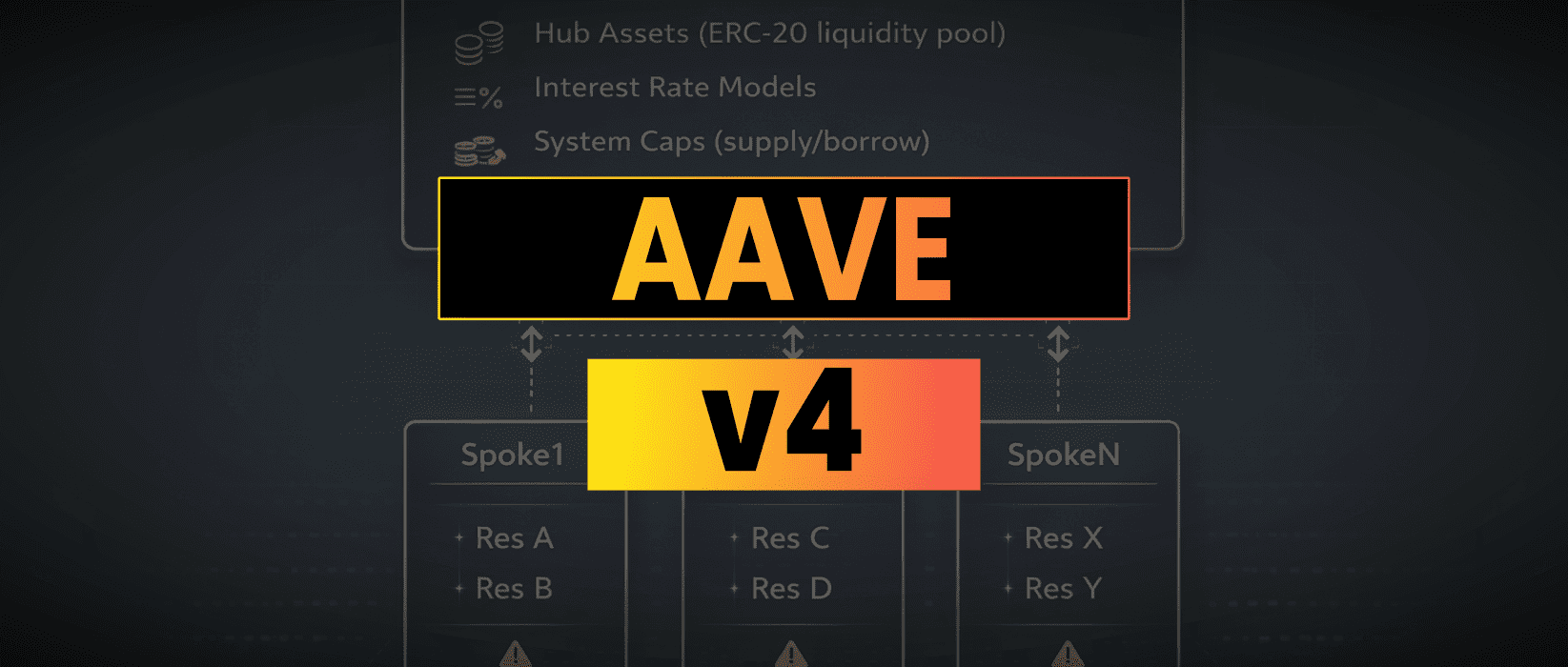
Aave v4 introduces a hub & spoke architecture that fundamentally restructures how liquidity and risk are managed compared to v3’s monolithic pool design.
The hub acts as a central liquidity coordination layer while spokes are isolated borrowing modules with independent risk profiles. This design delivers contagion isolation, specialized risk per market, and improved capital efficiency through targeted liquidity allocation.
1. Hub-and-Spoke vs Monolithic Pool Design
Aave v3: Monolithic Pool Architecture
- All deposits share one unified risk pool
- Every asset contributes to and draws from the same liquidity reservoir
- Cross-asset contagion risk: problems in one asset can affect the entire pool
- Risk parameters set globally, not granularly
Aave v4: Hub-and-Spoke Architecture
Hub Layer (Central Coordination)
The hub is the central liquidity coordination entity. Based on official documentation:
Hub Data Structure:
- Identification:
id,name,chain,address - Aggregated metrics:
totalSupplied,totalBorrowed - System caps:
totalSupplyCap,totalBorrowCap
interface Hub {
  __typename: "Hub";
  id: HubId;
  address: EvmAddress;
  chain: Chain;
  name: string;
  summary: HubSummary; // aggregates supply, borrow, caps
}
Hub Functions:
- Centralizes liquidity for cross-spoke availability
- Coordinates governance parameters across all spokes
- Manages oracle and price feed infrastructure
- Provides aggregate risk metrics and system-wide caps
Hub Assets
ERC-20 tokens held by the hub for liquidity and swaps:
interface HubAsset {
  __typename: "HubAsset";
  id: HubAssetId;
  onchainAssetId: OnChainHubAssetId;
  hub: Hub;
  underlying: Erc20Token;
  summary: HubAssetSummary; // supplied/borrowed, APY rates, utilization
  settings: HubAssetSettings; // fee receiver, liquidity fees, strategies
  userState: HubAssetUserState | null;
}
Key insight: HubAssets enable interest rate modeling at the hub level, with curves describing how supply and borrow rates change across the utilization range.
Spoke Layer (Isolated Markets)
Spokes are individual borrowing modules with isolated risk:
interface Spoke {
  __typename: "Spoke";
  id: SpokeId;
  name: string;
  address: EvmAddress;
  chain: Chain;
}
Spoke characteristics:
- Each spoke is an isolated market with its own risk profile
- Spokes can be discovered by chain ID or hub ID
- Individual active status and module settings per spoke
- Liquidation isolation between spokes
Reserve Layer (Asset-Specific Markets)
Reserves represent individual asset lending/borrowing conditions within spokes:
interface Reserve {
  __typename: "Reserve";
  id: ReserveId;
  onChainId: OnChainReserveId;
  chain: Chain;
  spoke: Spoke; // ← Each reserve belongs to a specific spoke
  asset: HubAsset;
  summary: ReserveSummary;
  settings: ReserveSettings;
  status: ReserveStatus;
  canBorrow: boolean;
  canSupply: boolean;
  canUseAsCollateral: boolean;
  canSwapFrom: boolean;
  userState: ReserveUserState | null;
}
Reserve data includes:
- Supply APY, liquidity, caps, collateral configuration
- Borrow APY, available liquidity, utilization rates, caps
- Collateral factor, liquidation bonus/fee, collateral risk
- Status flags: frozen, paused
Architecture Summary
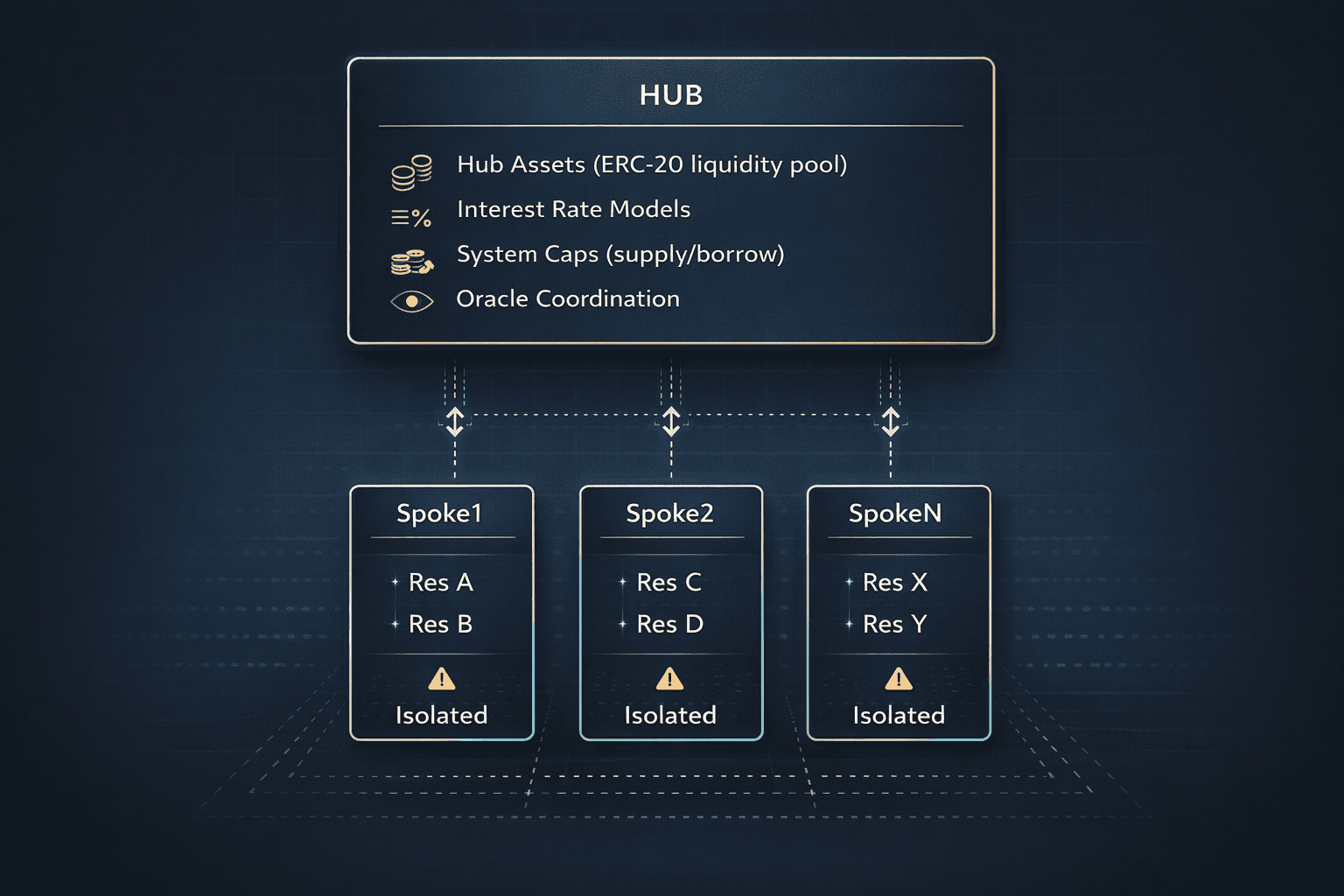
Key architectural insight: Reserves live inside spokes, and spokes pull liquidity from the hub. This means:- Liquidity is shared at the hub level (efficiency)
- Risk is isolated at the spoke level (safety)
- Each reserve has independent risk parameters
2. Liquidity Concentration Benefits
Capital Efficiency Improvements
- Targeted liquidity allocation: Spokes can focus liquidity on specific market segments without cross-subsidization from unrelated assets
- Reduced cross-asset subsidy effects: In V3, high-performing assets effectively subsidized riskier ones. V4 isolation eliminates this
- Hub-level liquidity pooling: Spokes can access shared hub liquidity when needed, avoiding capital fragmentation
- System caps: Hub-level caps (
totalSupplyCap,totalBorrowCap) provide system-wide risk limits while allowing spoke-level optimization
Interest Rate Model at Hub Level
The hub-level interest rate model enables:
- Utilization-based rate curves per hub asset
- Each data point includes: utilization rate, borrow rate, supply rate, liquidity distance from current state
- Rate adjustments happen at the hub asset level, not per-reserve
interface HubAssetInterestRateModelPoint {
  __typename: "HubAssetInterestRateModelPoint";
  utilizationRate: PercentNumber;
  borrowRate: PercentNumber;
  supplyRate: PercentNumber;
  liquidityDistance: Erc20Amount;
}
3. Spoke Market Isolation Mechanics
Spoke Creation and Parameterization
- Spokes are addressable entities on specific chains
- Each spoke has independent active status and module settings
- Discovery by chain ID or hub ID allows targeted spoke deployment
- Spoke parameters set at deployment time
Risk Parameter Independence
Each spoke maintains:
- Independent risk parameters
- Independent reserve configurations
- Independent liquidation conditions
- Independent frozen/paused states
Liquidation Isolation
- Liquidations are contained within individual spokes
- Problems in one spoke do not propagate to others
- Hub liquidity remains available to healthy spokes
Oracle Architecture
- Hub coordinates price feeds and oracle infrastructure
- Price data flows from hub to spokes
- Redundant oracle setup at hub level provides reliability for all spokes
4. Comparison to Compound V3 and Morpho
Compound V3 Comparison
| Feature | Compound V3 | Aave V4 |
|---|---|---|
| Isolation Model | Single-asset markets (one collateral asset per market) | Multi-asset spokes (multiple assets per spoke) |
| Liquidity Sharing | No cross-market liquidity | Hub-level shared liquidity |
| Governance | Single governance layer | Hub governance + spoke-level parameters |
| Risk Isolation | Complete (single asset) | Partial (spoke-level, multi-asset within spoke) |
Key difference: Compound V3 achieves isolation through extreme specialization (one collateral asset per market). Aave V4 achieves isolation at the spoke level while maintaining multi-asset functionality within each spoke, providing better user experience with comparable safety.
Morpho Comparison
| Feature | Morpho | Aave V4 |
|---|---|---|
| Architecture | P2P matching layer on existing pools | Native hub-and-spoke design |
| Base Layer Dependency | Depends on Aave/Compound pools | Self-contained protocol |
| Efficiency | Optimization on top of inefficiency | Native capital efficiency |
| Risk Inheritance | Inherits base protocol risk | Own isolated risk model |
Key difference: Morpho is an optimization layer that peer-matches lenders and borrowers within existing Aave/Compound pools. Aave V4 builds this optimization natively into the protocol architecture rather than bolting it on top.
Other Competitive Landscape
- Euler V2: Uses isolated lending markets similar to Compound V3
- Spark Protocol: Fork of Aave with some modifications
- Radiant Capital: Cross-chain Aave fork (omnichain model)
5. Governance Implications
Hub-Level Governance
- AAVE token holders govern hub parameters
- System-wide caps and risk parameters controlled through governance
- Emergency procedures and upgrade mechanisms
Spoke-Level Parameterization
- Spokes have independent module settings
- Risk parameters can be set per-spoke
- Active status managed per-spoke
Integration and Developer API
Aave V4 provides comprehensive SDK support:
@aave/react: React hooks for hub, spoke, reserve, and hub asset queries- GraphQL API for custom queries
- TypeScript interfaces for all data structures
- Solidity integration patterns
Available React hooks:
useHubs/useHub– Fetch hub lists and individual hubsuseHubAssets/useHubAssetInterestRateModel– Hub asset managementuseSpokes/useSpoke– Spoke discovery and detailsuseReserves/useReserve– Reserve management with filteringuseBorrowApyHistory/useSupplyApyHistory– Historical rate datauseHubSummaryHistory– Historical hub data
Query flexibility:
- By chain ID, hub ID, spoke ID
- By token/asset
- By user address
- By time window (day, week, month)
- By currency (USD, EUR, etc.)
- Filter by: supply, borrow, collateral categories
Upgradeability
- Hub-level upgrade mechanisms
- Timelock procedures for parameter changes
- Individual spoke deployment/retirement without affecting other spokes
Strengths of Hub-and-Spoke Design
- Contagion isolation: Problems in one spoke don’t cascade to others
- Capital efficiency: Hub-level liquidity sharing reduces fragmentation
- Specialized risk: Each spoke can have tailored risk parameters
- Governance flexibility: Hub governance with spoke-level parameterization
- Developer-friendly: Comprehensive SDK with React hooks and TypeScript
Potential Concerns
- Complexity: Multi-layer architecture (hub → spoke → reserve) is more complex than V3’s monolithic pool
- Hub single point of failure: If hub infrastructure fails, all spokes are affected
- Integration overhead: Developers need to understand three architectural layers
- Liquidity depth: Hub-level pooling may not be as deep as V3’s unified pool in edge cases
