
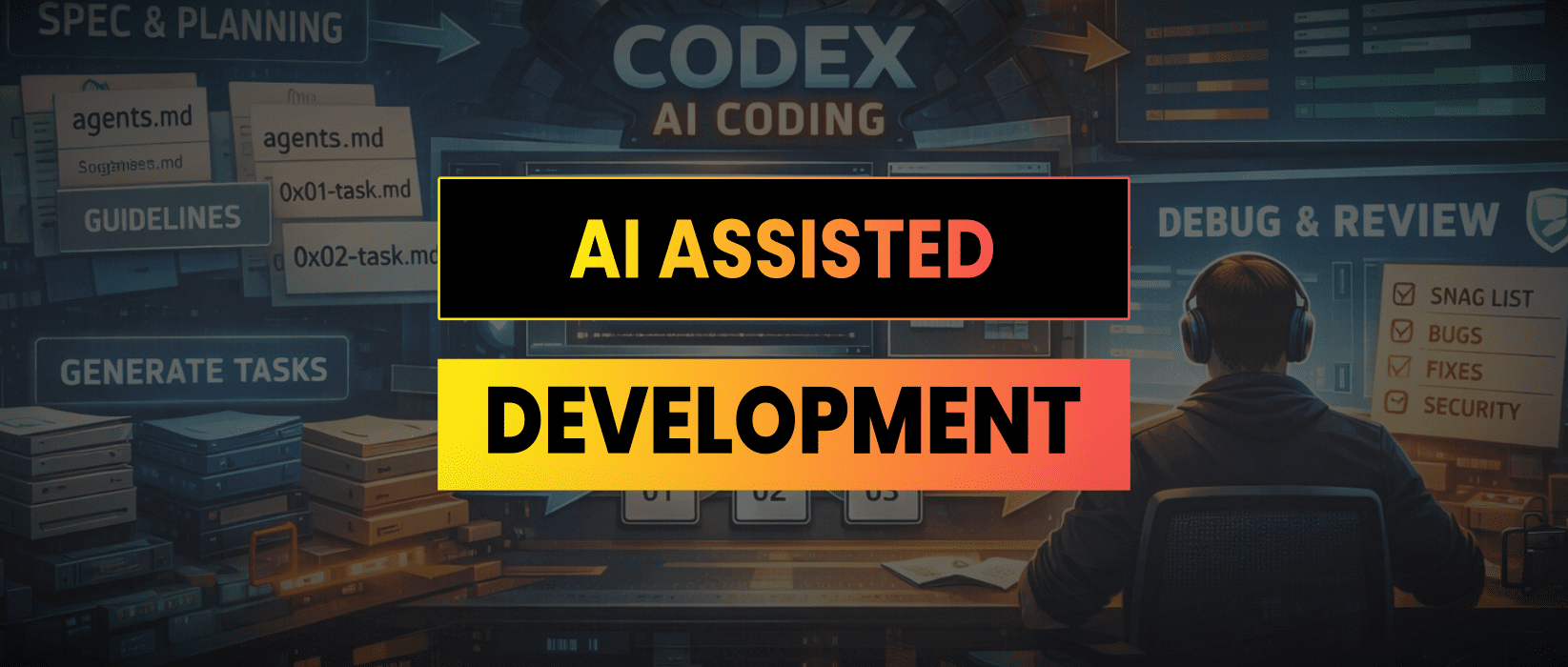
A practical, repeatable workflow for turning an idea into production-ready code using ChatGPT + Codex, with human review at every critical boundary. This is optimised for developers who want speed without surrendering architectural control.
This workflow separates thinking from typing:
- You own architecture, constraints, and quality bars
- ChatGPT helps crystallise intent into specs
- Codex executes scoped, testable tasks in parallel-safe chunks
- You review, deploy, and iterate with AI as a pair-programmer—not an autopilot
The key insight: AI performs best when it is given narrow, explicit tasks with completion criteria.
Step 1 — High-Level Design With ChatGPT
Goal: Convert a fuzzy idea into a clear technical spec before any code is written.
What to Discuss
- Problem statement
- Non-goals (very important)
- Constraints (language, framework, chain, infra, budget, security)
- Success criteria
- Open questions / assumptions
Example Prompt (Architecture Spec)
You are a senior software architect.

I want to build a [brief product description].

Constraints:
- Language: Rust + Soroban
- Frontend: Next.js
- Target environment: Stellar testnet
- Security: non-custodial, no admin key
- Non-goals: no governance, no upgradeability (for now)

Please produce:
1. A concise problem statement
2. High-level architecture
3. Data models
4. Key contract entrypoints
5. Threat model (top 5 risks)
6. Explicit non-goals
7. Open questions I need to decide
Output You Want
- A written spec, not code
- Something you could hand to another developer
- Clear enough that implementation is mechanical
Do not proceed until this feels right.
Step 2 — Create an AGENTS.md File
Goal: Define how Codex should behave across the entire repo.
This file becomes the “constitution” for automated coding.
Example AGENTS.md
# AI Agent Instructions

## General Rules
- Do not invent APIs or dependencies
- Prefer simplicity over cleverness
- No breaking changes without explicit instruction
- All code must compile

## Code Style
- Rust: idiomatic, no unsafe unless required
- JS/TS: strict typing, no `any`
- Comments explain *why*, not *what*

## Testing
- Every contract function must have unit tests
- Tests must assert failure cases
- Avoid mocks where possible

## Security
- No unchecked external calls
- Explicit authorization checks
- Fail closed, not open

## Output Rules
- Modify only files specified in the task
- Do not refactor unrelated code
- Explain assumptions at the end of each task
This dramatically improves consistency and reduces hallucinations.
Step 3 — Use Codex to Generate Task Files
Goal: Break the project into small, serialisable tasks with clear completion criteria.
Run Codex locally (WSL works well) using a high-capability coding model.
I’ll also update the ~/.codex/config.toml file with the example from Peter Steinberger
model = "gpt-5.2-codex"
model_reasoning_effort = "high"
tool_output_token_limit = 25000
# Leave room for native compaction near the 272–273k context window.
# Formula: 273000 - (tool_output_token_limit + 15000)
# With tool_output_token_limit=25000 ⇒ 273000 - (25000 + 15000) = 233000
model_auto_compact_token_limit = 233000
[features]
ghost_commit = false
unified_exec = true
apply_patch_freeform = true
web_search_request = true
skills = true
shell_snapshot = true

[projects."/mnt/c/code"]
trust_level = "trusted"
Initial Codex Prompt
You are an autonomous coding agent.

Using the provided spec and AGENTS.md:
- Decompose this project into a sequence of tasks
- Each task must be independently executable
- Tasks should build on each other
- Each task should produce a concrete output

Create one markdown file per task named:
tasks/0x01-task.md, 0x02-task.md, etc.

Each task file must include:
- Objective
- Files to modify
- Detailed steps
- Completion criteria
Example Task File (tasks/0x01-task.md)
## Objective
Set up the base Soroban contract with storage layout and skeleton functions.

## Files to Modify
- contracts/src/lib.rs
- contracts/Cargo.toml

## Steps
1. Create contract struct
2. Define storage keys
3. Add placeholder entrypoints
4. Ensure contract compiles

## Completion Criteria
- `cargo test` passes
- No unused imports
- No TODOs left in code
Think of these as mini-specs, not tickets.
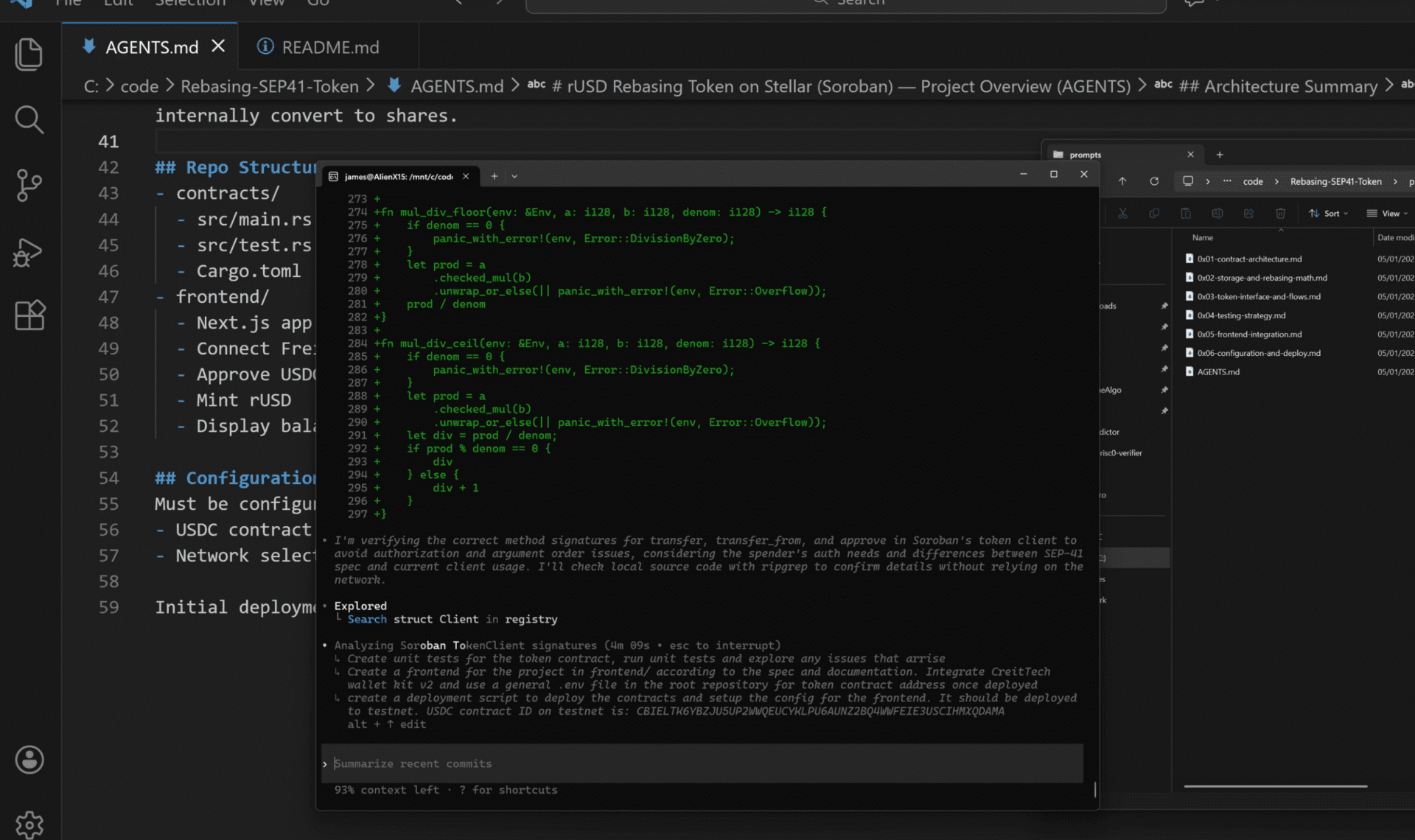
Step 4 — Schedule & Execute Tasks Sequentially
Let Codex work in the background while you stay in control.
Best Practices
- Run one task at a time
- Review output before continuing
- Reject or revise tasks aggressively
- Keep diffs small
Execution Prompt Template
Execute tasks/0x02-task.md exactly as written.

Rules:
- Modify only the listed files
- Do not anticipate future tasks
- If something is unclear, state assumptions
- Stop when completion criteria are met
This avoids cascading errors and architectural drift.
Step 5 — Deploy, Test, Snag, Iterate
The next step is to see if it actually works and then fix everything that is meh.
At this stage I also like to carry out a security review using a couple of the leading models. Usually Codex & Claude. Different models catch different classes of issues.
Security Review Prompt
Perform a security review of this Soroban contract.

Assume:
- Adversarial users
- No trusted off-chain components

List:
- Attack vectors
- Severity
- Concrete mitigations
Some notes on AI assisted development
- Specs are leverage
- Tasks are contracts
- AI writes code, you ship systems
- Small scopes beat big prompts
- Review is not optional
If something goes wrong, it’s almost always because:
- The spec was vague
- The task was too large
- Completion criteria were missing
When This Workflow Shines
- New protocols or chains
- Complex smart contracts
- Greenfield projects
- Rapid prototyping with production intent
- Solo developers acting like a small team
Treat AI like a junior developer with infinite stamina and zero intuition. Git it hard boundaries, clear criteria and let it work overtime to create the best products possible.
